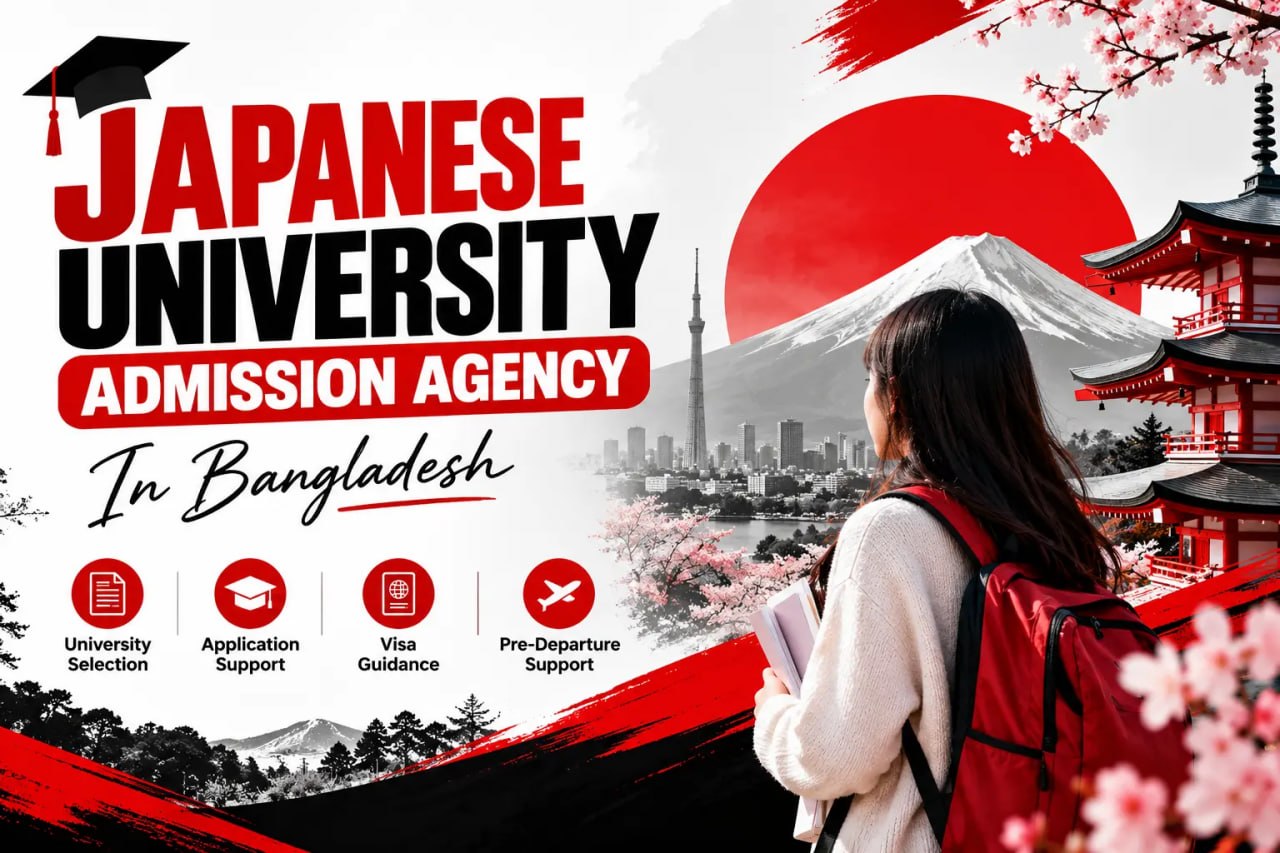
Hello From Japan is a Japan university admission agency in Bangladesh that runs directly from Japan, with an office in Bangladesh. We guide students from the first question to arrival, covering Master's and PhD admission, scholarships, COE and the Japan student visa, so you deal with one team from start to finish.
Why study in Japan from Bangladesh?
Japan is worth serious consideration if you want strong research training at a fair price, and it is not worth it if you are only chasing a quick way abroad. Here is the honest version.
- Research and quality. Japanese national universities run well-equipped labs and give graduate students close supervision from a named professor, which suits anyone planning a Master's or PhD.
- Fair tuition at national universities. Fees at national universities are set by the government and are far below what many private or Western universities charge (figures in the cost section below).
- English-taught programs exist. You do not always need Japanese to start. Many graduate programs, and some undergraduate ones, teach in English, though daily life will be easier if you learn the language.
- Scholarships are real. From the MEXT scholarship to university tuition reductions, funding exists, but it is competitive and has deadlines.
- Safe, orderly and well connected. Most students find Japan a calm, practical place to live and study.
And the other side: it is not automatically cheap, the paperwork is strict, and even a little Japanese will help you a lot once you are there. Go in with open eyes and you will do fine.
Which level fits you? Bachelor's, Master's, PhD or language school
Your current qualification decides your starting point, and the table below gives the usual picture. Treat it as orientation only: each university and program sets its own Japan university admission requirements.
|
Level |
Usually need |
Language evidence |
Usual length |
|---|---|---|---|
|
Bachelor's |
HSC or equivalent (about 12 years of schooling) |
English or Japanese, depending on the program |
4 years |
|
Master's |
A relevant Bachelor's degree (about 16 years) |
English or Japanese, depending on the program |
2 years |
|
PhD |
A relevant Master's degree (about 18 years) |
English or Japanese, depending on the program |
3 to 5 years |
|
Japanese language school |
Usually HSC or equivalent; check each school |
Japanese study plan; some schools take beginners |
Varies by school |
A Japanese language school is a different route: you study Japanese first and then move on to a university or vocational school. It suits students who want Japanese-taught programs or who are not yet ready for an English-taught degree.
How to study in Japan from Bangladesh: the step-by-step route
Here is the route for Japan university admission 2027 and the years after. It is the same in outline for almost everyone, and the details change with your level and program. Follow the steps in order and you will avoid most of the usual mistakes.
- Choose your level, field and study language. Decide whether you are aiming for a Bachelor's, Master's or PhD, and whether you will study in English or Japanese.
- Shortlist programs. Read the current admission page of each department, not an old list. Requirements differ even inside one university.
- Confirm your language evidence. Check whether the program wants IELTS, TOEFL, a Medium of Instruction (MOI) certificate, or JLPT or EJU for Japanese-taught courses.
- Contact a professor (research degrees). For most Master's and PhD programs, supervisor contact matters. More on this below.
- Prepare your documents. Academic certificates and transcripts, SOP or research plan, recommendation letters, passport copy, financial evidence, and any university forms and fee receipts.
- Apply before the deadline. Deadlines are strict, and scholarship deadlines can come earlier than admission deadlines.
- Wait for the admission result, then the COE. After admission, the school applies for your Certificate of Eligibility (COE) with Japanese immigration.
- Apply for the student visa. Use your COE to apply for the visa at the Embassy of Japan in Bangladesh, following the current official instructions.
- Prepare to travel. Sort out money, accommodation, insurance and flights.
One point trips up many applicants: an admission offer is not a COE, and a COE is not a visa. Each is a separate step with its own decision-maker.
How to choose a Japan university admission agency in Bangladesh
A good Japan university admission agency in Bangladesh makes your path clearer and cheaper, and a bad one can cost you money and a whole year. Before you sign or pay anything, ask these questions and listen carefully to the answers.
- Are the fees in writing? You should get a clear, itemised list of what you pay, what is refundable, and when.
- Do they promise a visa or a scholarship? If they do, walk away. Nobody can guarantee either, because the decision is never theirs.
- Will they match you with a real supervisor? For a Master's or PhD, this is the part that decides your result, so ask exactly how they help.
- Can they show real results? Look for visa approvals and acceptance letters you can see, not just big numbers on a banner.
- Will they tell you when Japan is not the right fit? An honest agency sometimes says "not yet" or "try a different route."
- Do you stay in control of your own application? You should know every university you are applying to, and keep your own copies of every document.
- Do they support you after you land? Accommodation, a bank account and city registration are where students often feel most alone.
That is the standard we try to hold ourselves to as well.
Top 5 Japan university admission agencies in Bangladesh
Here is our short list of the top 5 Japan university admission agencies in Bangladesh. We are one of them, so please read it with that in mind: first place is our own view, and the others are described only from what their public pages say. Use the checklist above to compare them for yourself.
1. Hello From Japan
Our pick for number one, and here is why. Hello From Japan keeps control of the whole process in one team and organizes everything directly with Japan, from choosing the university and talking to professors to the COE, the visa and your arrival. That means fewer handovers, fewer surprises, and one place to ask when something is unclear. The focus is Japanese national and public universities, especially Master's and PhD applicants, with supervisor matching, SOP and research plan review, and arrival support. Best for: graduate applicants who want hands-on guidance from the first question to the first week in Japan.
2. Meiji Education
A Dhaka-based consultancy and Japanese language school with offices in Dhaka and Cumilla. Its Japan page highlights N5 and N4 Japanese courses, IELTS coaching, file processing and visa support, and shows a 4.8 Google rating from 231 reviews. Best for: students who want language classes and file processing under one roof.
3. MACES Education Consultancy
A study abroad consultancy that says it was established in 2007 and works across Japan, the UK, the USA, Canada, Australia and Malaysia. It says it has placed more than 1,500 Bangladeshi students in Japanese universities, and its Japan page covers scholarship guidance at several private universities. It also states that its counselling is free apart from a fully refundable TK 5,000 deposit. Best for: undergraduate applicants looking at private universities and scholarships.
4. Chanto Education
A Dhaka language school and consultancy in the Uttara area. Its public listing shows mostly positive student reviews about Japan student visa processing. Best for: students who want a local Japanese language school with visa file support.
5. GoGlobal
A multi-country study abroad consultancy. Its Japan page lists document checklists for admission and visa applications and mentions free IELTS training. Because it covers many destinations, ask how much Japan-specific experience your counsellor has. Best for: students who are still comparing several countries.
Whoever you choose, get the fees in writing, ask the questions in the checklist above, and never pay anyone who promises you a visa or a scholarship. For free, official advice, the Embassy of Japan in Dhaka also runs a free educational counselling service.
Master's and PhD in Japan for Bangladeshi students
For a Master's in Japan or a PhD in Japan from Bangladesh, the professor matters as much as the university. A strong supervisor match, backed by a clear research plan, is usually what turns an application from "possible" into "accepted."
Find the right supervisor. Search department websites and recent papers in your area. Look for a lab whose work genuinely overlaps with your thesis or experience, not just a famous name.
How to contact a Japanese professor: write a short, honest first email. Keep it to a few lines:
- A clear subject line with your degree level and field.
- Who you are: degree, university, and one or two relevant results.
- Why this lab: mention a specific paper or topic that you read.
- Your research idea in two or three sentences.
- Attach your CV and a one-page proposal, and ask about openings and the next intake.
Do not send the same message to fifty professors. Professors notice, and a personal, specific email gets a reply far more often.
Build your Japan research proposal and SOP. A simple, solid structure is: purpose, background, significance, methodology, references. Tie the topic to the supervisor's work and keep your claims backed by evidence.
Know the funding routes.
- MEXT Embassy Recommendation: you apply through the Embassy of Japan in Bangladesh, with document screening, and possibly written exams and an interview.
- MEXT University Recommendation: a Japanese university nominates you, so supervisor contact is often essential.
- JDS scholarship: a route for eligible Bangladeshi government officials, with its own nomination rules.
- Self-funded: you cover tuition and living costs yourself, so plan the budget early.
Common mistakes: contacting supervisors too late, a vague proposal, missing scholarship deadlines, and assuming every scholarship has the same rules.
Study in Japan without IELTS: what actually works
You can sometimes study in Japan without IELTS, but "without IELTS" never means "without any language proof." IELTS is not a universal rule for Japanese admission or for the student visa. What counts depends on the university, the program and the scholarship route.
Here are the real alternatives:
- Another English test. Some programs accept TOEFL, TOEIC, Cambridge English, Duolingo English Test or PTE. Score requirements vary.
- English-medium education. If your previous degree was taught fully in English, some programs may waive the test when you provide proof.
- MOI certificate. An official letter from your previous institution is accepted by some programs, not all.
- Japanese-taught program. You will need real Japanese ability, often shown through JLPT or EJU.
- Japanese language school. IELTS may not matter here, but your Japanese study plan and immigration documents will.
- MEXT scholarship route. Selection may use its own exams and interviews, though a university can still ask for language evidence.
Be careful with these:
- Do not assume every university accepts an MOI certificate.
- Check the score validity period of any test you already hold.
- Do not confuse what the university needs for admission with what immigration needs for the visa.
- Always confirm on the current official admission page for your exact department, degree and intake.
Japan scholarships for Bangladeshi students
There are three main kinds of Japan scholarship for Bangladeshi students, and the right one depends on your level, your timing and your profile. Do not apply for everything at once without reading the conditions.
1. MEXT (Japanese government) scholarship. The best-known route, usually covering tuition and a monthly stipend, and often more for research students. Past announcements put the monthly stipend at roughly ¥117,000 to ¥145,000 depending on level, but amounts and eligibility change, so confirm in the current announcement. There are two ways in: the Embassy Recommendation (applied through the Embassy of Japan in Bangladesh) and the University Recommendation (the university nominates you).
2. JASSO and other support. The Japan Student Services Organization offers scholarships and support to some international students, often those already enrolled. Read its current conditions carefully, because rules differ between programs.
3. University tuition reductions. Many private universities offer partial or full tuition reductions based on your academic profile, language level or interview. These are usually decided at admission, so ask about them when you apply, not after.
JDS is also worth knowing about if you are a Bangladeshi government official, since it has its own nomination route.
A few rules of thumb: start early, because scholarship deadlines often come before admission deadlines; never assume a scholarship covers flights, insurance and set-up costs; and treat any agency that promises a scholarship as a red flag. Nobody can guarantee one.
Japan study cost in BDT: what it really takes
The cost of studying in Japan depends mostly on whether you choose a national or a private university, and on the city you live in. The figures below are indicative estimates from our own guides as of 2026, not quotations, so confirm them with each university.
|
Cost item |
Indicative figure |
What to know |
|---|---|---|
|
National university tuition |
About ¥535,800 per year |
Set by the government, so it is the same at most national universities |
|
Private university tuition |
About ¥800,000 to ¥2,000,000 per year |
Varies a lot by subject; medicine and science cost more |
|
One-time admission fee |
About ¥282,000 |
Usually paid once, at enrolment |
|
Living costs |
Varies by city |
Tokyo and Osaka cost more than smaller cities |
To work out your Japan study cost in BDT, multiply the yen figures by the current yen-to-taka exchange rate on the day you check, since it moves. Then add the extras people forget: health insurance, accommodation deposit, flights, and your first month of living costs.
A scholarship or a tuition reduction can change the picture a lot. When you talk to us, we give a written breakdown of tuition, accommodation and living costs before you commit, so you can plan the cost of studying in Japan from Bangladesh against your family's budget without surprises.
COE vs Japan student visa, and what to do if your Japan visa is refused
The Certificate of Eligibility (COE) and the Japan student visa are two different things, and mixing them up causes a lot of panic. The COE is issued through Japanese immigration after your school applies for it. The visa is then issued by the Embassy of Japan, using your COE.
Documents you will usually need. The exact list comes from your school and the embassy, but expect most of these:
- Valid passport and visa application form
- Passport-style photos that meet the photo rules
- Your COE and admission letter
- Original academic certificates and transcripts
- Proof of funds showing who is paying and how
- Tuition payment receipt, if the school asked for payment
Check every form before you submit it. A small mismatch between two documents, such as a name or a date, can slow things down more than people expect.
If your Japan visa is refused, here is what to do next: Do not panic, and do not rush a second attempt. Ask what went wrong, review the documents, and fix the actual cause before you reapply. Refusals are often tied to incomplete or inconsistent paperwork, or to financial evidence that is not clear. At Hello From Japan, we review the reason and prepare a corrected reapplication without an extra service charge, though you should confirm the exact terms with us. A reapplication never guarantees approval.
Part-time work and life after graduation
Most students on a student visa can take part-time jobs in Japan, but only with permission and within limits. The usual rule is up to 28 hours a week during term, with longer hours allowed during official school holidays. Confirm the current rules with Japanese immigration, because the details matter and mistakes can affect your visa.
Part-time work helps with daily costs, but it should not be your plan for paying tuition. Treat it as a supplement.
After graduation, graduates can look for work in Japan, and working in Japan after study is possible under the right visa conditions. Language ability, your field and the job market all play a part. We will not promise a job or permanent residency, and you should be wary of anyone who does.
Arriving in Japan: your first weeks
The first few weeks go much more smoothly when you have a short list ready before you land.
- Accommodation. Book your first place before you travel, whether a dormitory, a share house or a rented room.
- City registration. You usually need to register your address at the local ward or city office soon after you move in, commonly within 14 days. Confirm the current rule on arrival.
- Health insurance. Students normally join the national health insurance system, so ask your school or ward office how.
- Bank account. Opening one is much easier with your residence card, address and an understanding of what your bank requires.
- Phone and transport. Sort out a SIM or phone plan and a transport card early.
We help students with accommodation guidance, bank account support and city registration, so the first weeks feel less like a maze.
A realistic timeline
Plan for roughly six to nine months from your first consultation to your arrival in Japan, and start researching about a year before your target start date. That is an estimate, not a promise, because it depends on the intake and on how fast you gather your documents.
- Months 1 to 2: consultation, shortlist, language evidence, and supervisor contact for research degrees.
- Months 2 to 4: SOP or research plan, recommendation letters, applications, and scholarship forms.
- Months 4 to 6: admission results, interviews if required, and the school's COE application.
- Months 6 to 9: visa application, finances, accommodation and travel.
Intakes differ by school. Many universities admit students in spring and autumn, and Japanese language schools often have April, July, October and January intakes. Confirm the dates for each school you pick.
How Hello From Japan helps as your Japan university admission agency
As a Japan university admission agency in Bangladesh, we guide you from your first question to your arrival, and we try to keep it practical and honest. Our focus is on Japanese national and public universities, with special attention to Master's and PhD applicants.
- University and program selection based on your grades, budget and goals.
- Supervisor matching and professor communication for research degrees.
- SOP and research plan review, plus interview preparation.
- COE and Japan study visa support, with document checks before submission.
- Japanese language and JLPT guidance, and language school placement.
- Arrival support: accommodation, bank account and city registration guidance.
How it works:
- Free consultation. We talk about your background and goals and find realistic options.
- Application and documents. We prepare, translate and check your documents before submission.
- Visa and departure. After acceptance, we work through the visa process and get you ready to travel.
You can see real visa approvals and acceptance letters on our success gallery. Ready to talk? Book your free consultation through the contact form on hellofromjapan.org.
Frequently asked questions about studying in Japan from Bangladesh
Can I study in Japan after HSC?
Yes. HSC or an equivalent 12-year qualification is the usual entry point for a Bachelor's program or a Japanese language school. Studying after SSC alone is not the normal route.
Do I need to know Japanese before I apply?
Not always. Some universities offer English-taught programs and some language schools accept beginners, but the requirement depends on the institution and program.
Can I study in Japan without IELTS?
Sometimes. Some programs accept another English test, an MOI certificate, or Japanese proof instead. Check the exact department's current rules, and do not assume every university does the same.
How much does it cost to study in Japan?
It depends on the university and city. National university tuition is about ¥535,800 a year and private tuition is often ¥800,000 to ¥2,000,000, plus a one-time admission fee and living costs. Ask for an itemised estimate.
How long does the whole process take?
About six to nine months from consultation to arrival is a fair estimate, depending on your intake and how quickly you prepare documents.
How does the MEXT scholarship work?
The MEXT scholarship has an embassy route and a university route, each with its own steps, exams and deadlines. Read the current announcement for your year.
Is there an age limit?
There is no single age limit for all Japanese university admission, but scholarships such as MEXT set their own age and eligibility rules.
Can I work while I study?
Often yes, part-time and with permission, within the weekly hour limits. Confirm the current immigration rules.
What if my Japan student visa is refused?
Find out why, fix the real problem, and reapply with corrected documents. A reapplication does not guarantee approval.
Do I need a Japan university admission agency in Bangladesh?
No, you can apply on your own. A good agency saves time and avoids avoidable errors, especially with supervisor contact, research plans and visa paperwork. Choose one that is open about its fees, never promises a visa or scholarship, and answers your questions plainly.